
Introduction
In 2026, India’s education technology ecosystem found itself at the center of a major cybersecurity discussion after a 19-year-old security researcher claimed to have discovered multiple critical vulnerabilities in the Central Board of Secondary Education (CBSE) On-Screen Marking (OSM) platform.
The incident quickly gained national attention because the OSM platform was designed to digitize the evaluation of Class 12 answer sheets—a process impacting millions of students annually. The researcher alleged that vulnerabilities within the portal could potentially allow unauthorized access to examiner accounts and evaluation functions. CBSE later clarified that the reported issues existed on a testing environment and not on the production platform used for actual answer-sheet evaluation. (The Times of India)
Regardless of where the vulnerabilities existed, the incident provides valuable lessons for software companies, government agencies, educational institutions, and enterprises undergoing digital transformation.
At HW Infotech, we believe this case highlights the importance of secure software architecture, vulnerability management, responsible disclosure, and continuous cybersecurity monitoring.
Understanding the OSM System
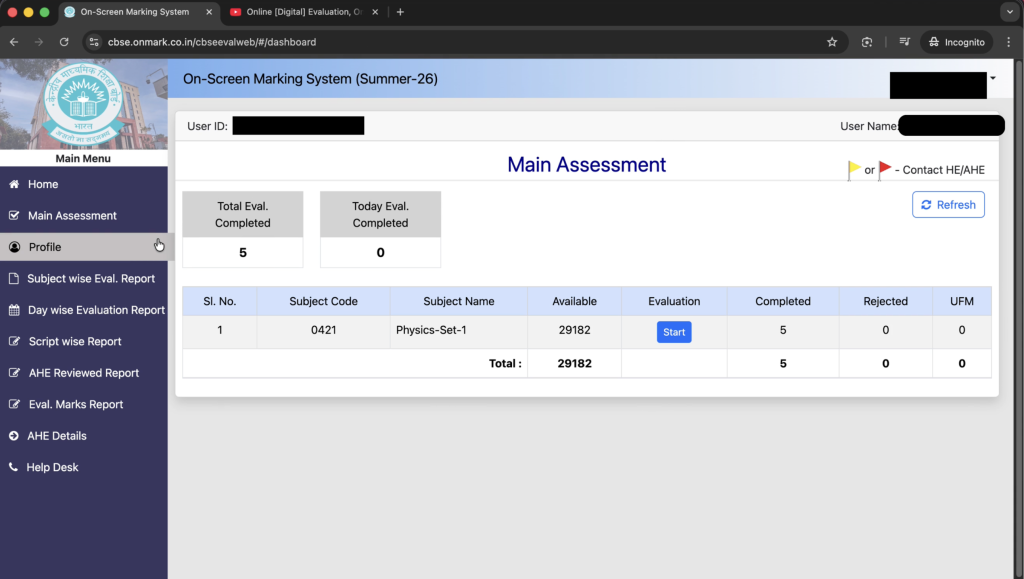
CBSE introduced On-Screen Marking (OSM) in 2026 to modernize answer-sheet evaluation.
The objectives included:
- Faster evaluation
- Reduced manual errors
- Improved transparency
- Digital audit trails
- Better examiner productivity
According to CBSE, answer books are scanned and evaluated digitally by examiners rather than through traditional paper-based checking. (The Times of India)
Digital evaluation systems are becoming increasingly common worldwide.
Global EdTech Statistics
The global education technology market is expected to exceed $400 billion by 2030 according to multiple industry forecasts.
Key trends driving adoption include:
- Digital examinations
- AI-assisted assessment
- Remote learning
- Automated grading systems
- Cloud-based student management
However, as educational systems become digitized, they also become attractive targets for cybercriminals.
What the Researcher Claimed
According to publicly available reports and technical write-ups, the researcher identified several vulnerabilities.
The claims included:
1. Hardcoded Credentials
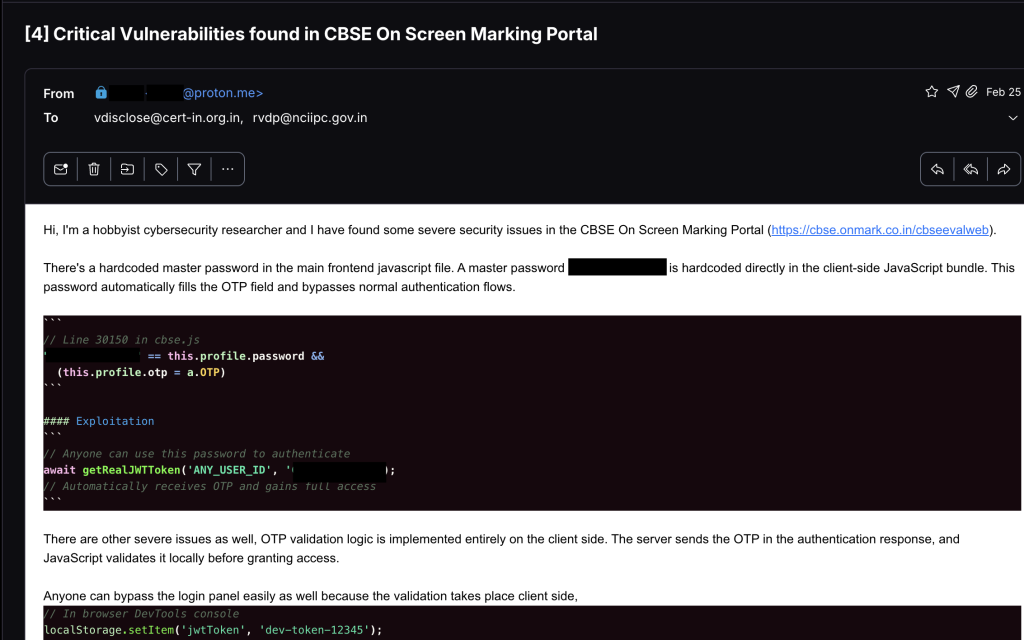
One of the most serious findings involved a master password allegedly embedded inside frontend JavaScript code.
From a cybersecurity standpoint, this violates one of the most fundamental security principles:
Secrets should never be exposed client-side.
If credentials are present in browser-delivered code, anyone can inspect them.
2. Client-Side OTP Validation
The researcher claimed OTP validation logic was handled by the browser rather than being fully enforced on the server.
This creates risks because:
- Browsers are controlled by users
- Client-side logic can be modified
- Attackers can bypass validations
Modern authentication systems should always validate security decisions server-side.
3. Weak Password Reset Process
The report suggested password changes could occur without properly validating existing credentials.
Password reset vulnerabilities remain one of the most common causes of account compromise worldwide.
4. Broken Access Controls
The researcher described what appeared to be an Insecure Direct Object Reference (IDOR) issue.
OWASP consistently ranks Broken Access Control among the most dangerous web application vulnerabilities.
In 2021, Broken Access Control ranked as the #1 risk in the OWASP Top 10 list.
5. Authorization Weaknesses
According to the findings, the server allegedly trusted identifiers supplied by the client.
This is dangerous because:
- User identity should come from authenticated sessions.
- Clients should never decide authorization.
- Every request must be validated server-side.
These principles form the foundation of secure application architecture.
Why This Incident Matters
Many people viewed this story as a government portal issue.
In reality, it is a lesson for every software company.
The vulnerabilities discussed are not unique to educational platforms.
They can exist in:
- Banking systems
- Healthcare applications
- E-commerce platforms
- SaaS products
- Government portals
- Enterprise software
Every organization handling sensitive data faces similar risks.
The Cost of Data Breaches
Cybersecurity incidents are becoming more expensive every year.
According to IBM’s Cost of a Data Breach Report:
- Average global breach cost exceeds $4 million.
- Detection and escalation often consume the largest share of expenses.
- Reputational damage can last years.
For public institutions, trust damage may be even more costly than financial loss.
Why Testing Environments Matter
One of the most overlooked lessons from this case is the importance of securing staging and testing systems.
Organizations often focus heavily on production environments while neglecting:
- Development servers
- QA systems
- Test portals
- Internal tools
Attackers frequently target these systems because:
- Security controls are weaker
- Monitoring is limited
- Sensitive information may still be exposed
CBSE clarified that the reported portal was a testing environment rather than the live evaluation system. (The Times of India)
However, secure development practices require testing environments to receive the same level of protection as production systems.
The Role of Ethical Hackers
The incident also demonstrates the importance of ethical hacking.
Security researchers help organizations:
- Identify vulnerabilities
- Improve defenses
- Prevent future attacks
- Strengthen public trust
Many major companies operate bug bounty programs.
Examples include:
- Microsoft
- Meta
- Shopify
These programs reward researchers for responsibly disclosing vulnerabilities before attackers discover them.
India’s Growing Cybersecurity Challenge
India is among the world’s fastest-growing digital economies.
The country now processes billions of digital transactions annually and operates massive online platforms across:
- Education
- Healthcare
- Banking
- Governance
As digital adoption grows, cyber threats grow alongside it.
Government reports indicate thousands of cybersecurity incidents are reported every year.
Educational institutions have become particularly attractive targets because they store:
- Student records
- Examination data
- Personal information
- Identity documents
Secure Development Best Practices
At HW Infotech, we recommend the following cybersecurity measures for all software projects.
Security by Design
Security must begin during architecture planning.
It cannot be added later.
Zero Trust Principles
Never trust:
- Users
- Devices
- Networks
- Client-side code
Every request should be verified.
Secure Authentication
Implement:
- Multi-factor authentication
- Server-side validation
- Session security
- Strong password policies
Regular Penetration Testing
Independent testing identifies weaknesses before attackers do.
Continuous Monitoring
Organizations need:
- Log monitoring
- Threat detection
- Security analytics
- Incident response planning
Lessons for Business Leaders
Executives often view cybersecurity as an IT issue.
It is actually a business issue.
A single vulnerability can impact:
- Revenue
- Brand reputation
- Customer trust
- Regulatory compliance
Board-level involvement in cybersecurity strategy is now essential.
The Future of Secure Digital Education
India’s education sector will continue adopting technology at scale.
Future innovations may include:
- AI-based evaluations
- Adaptive testing
- Blockchain certificates
- Digital credentials
- Remote examinations
These innovations create tremendous opportunities.
But they must be supported by strong security foundations.
Conclusion
The CBSE OSM controversy is more than a story about one portal or one researcher.
It is a reminder that cybersecurity must be treated as a core business function.
Whether you are building an educational platform, an enterprise SaaS product, or a government application, the same principles apply:
- Protect credentials
- Validate server-side
- Enforce access controls
- Secure testing environments
- Conduct regular security assessments
Digital transformation succeeds only when security evolves alongside innovation.
At HW Infotech, we help organizations build secure, scalable, and future-ready digital platforms that prioritize both innovation and cybersecurity from day one.
Because trust is built through security—and security begins with good software engineering.
Media Coverage
A lot of famous personalities and organizations likeDeedy Das,Satish Acharya,Internet Freedom Foundationtweeted about it & this blog has been featured in news reports by multiple media outlets:
- India Today
- BBC News
- Bloomberg
- NDTV
- Times of India
- The Hindu BusinessLine
- ThePrint
- News18
- Scroll
- Hindustan Times
- Financial Express
- Times Now
- CNBC TV18
- Moneycontrol
- IFF Blog
- Medianama
- Free Press Journal
- Careers360
Thanks